Clear, 51° F
I’m a history buff, and from early on the American Revolutionary period has been particularly interesting to me. The lead-up to the conflict, specifically, is fascinating, with our …
This item is available in full to subscribers.
The Powell Tribune has expanded its online content. To continue reading, you will need to either log in to your subscriber account, or purchase a subscription.
If you are a current print subscriber, you can set up a free web account by clicking here.
If you already have a web account, but need to reset it, you can do so by clicking here.
If you would like to purchase a subscription click here.
Please log in to continue |
|
I’m a history buff, and from early on the American Revolutionary period has been particularly interesting to me. The lead-up to the conflict, specifically, is fascinating, with our founding fathers and others almost lost to history leading the protests and acts of civil disobedience that lead to an outbreak of hostilities with the British Empire.
One of those acts of civil disobedience, directed often against representatives of the crown in American cities, was tar and feathering. The sketches make it look quite humorous — obviously not for the person tarred and feathered — and I always thought: That’s a fairly tame assault on someone, at least it’s not a club to the knees.
On a Saturday in September, I would’ve gladly taken said club to the knees if it would have meant an end to the goopy tar solidifying all over my arms, my hair and other areas I only later discovered. I had time to discover blotches of tar in odd places because, for those of you who have never experienced tar like I have, it’s dang near impossible to get off. I only just avoided the feathering part, as feathers from our molting chickens are apt to catch the wind and blow around me when the wind picks up.
You see, I always imagined those British officials simply went home after their humiliation and washed off in a basin of water, suffering mostly pain to their pride. Now, I can’t help but feel at least a little bit sorry for them, even if many deserved the ire of the patriots.
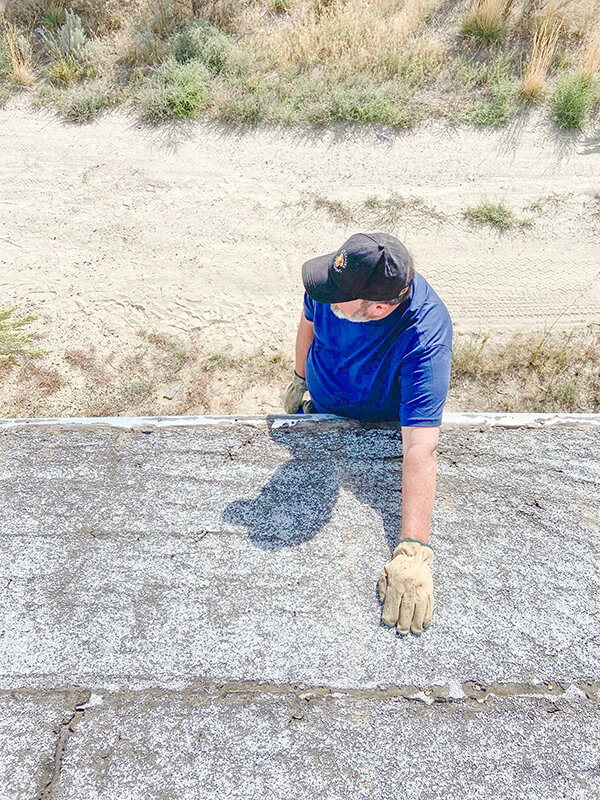
The moral of my story? When you’re putting on rolled roofing, especially the type with a sticky backside, keep the plastic covering the sticky side on until you are actually rolling out that section. In the end, when my father and I were on a roll (lame pun), I was standing on the roof and pulling the plastic off the down side of the roll as it was coming into contact with the tar-covered roof. We felt pretty good about ourselves at that point, but by then we were both also covered in tar.
Why did we even use tar if we had self adhesive rolled roofing? Well, my dad has a very good theory on that after a lifetime of replacing rolled asphalt roofing on our old family cabin in the Laramie Mountains near Douglas. Even the self adhesive doesn’t last long against the Wyoming winds, while tar is incredibly adhesive.
We know that all too well now. The problem was, with our first chunk of the roll, we extended it out, took off the plastic covering the adhesive section and then climbed our ladders to each side of the roof. During that process I didn’t do so great of a job keeping the roofing from folding on itself, only after the bottom had been covered in tar of course, leading the folded halves to stick together. I then frantically tried to separate the sides again by shoving my arms into the middle of the crease, which only succeeded in leaving my arms covered in tar up to the elbows.
After a trip to Bloedorn for advice, contact info for professional roofers in case we gave up, and some gritty orange soap, we rallied and finished the roof.
We figured it out after that, and were able to piece together just enough of the folded over first section to finish the roof.
Then we tried cleaning off all of the tar that had already ruined a holey pair of gloves (hence all of the tar on my hands), a good pair of gloves, both of our shirts that we were prepared to lose anyway and a tape measure, not to mention leaving black stains on two hammers, my old boots and pants, and even the doors of my Ford Ranger.
First we tried hosing ourselves down. Nothing.
Then we brought out the orange soap with grit, and it worked to an extent, but it hurt. Rubbing furiously with hands or a towel brought off some tar, but also pulled out hair, making for a painful experience.
I washed my hands at least a dozen times that day, took a long shower, and still had random specks of tar in various places (like on my back just above my poor, tarred leather belt) that I spent the next few days getting rid of. I’d talk with my dad and he’d share the same experience of only getting tar from places like his fingernails or elbow days later.
We’ve both recovered from the tar and my family now has a nice new roof on our shed at home, which I can look at and smile as I think if the hard work it took to put it on.
But I think the tar experience has scarred me. Two weeks after the tar incident I finished loading up my F-250, where I had loaded the excess, tar-covered rolled roofing and other items destroyed by tar, to take to the dump. While gingerly taking out the rolled roofing to not get any more tar on me, I brushed my hand on the side of the bed — which still had a goop of tar on it.
Seriously, how did people in the 1600s or 1700s cope with being tarred and feathered?
On an unrelated note, anyone want some leftover tar?